Korsaa Aps
Conditions for success
The early and ongoing conditions that determine whether a project has a fair chance to succeed: mandate, decisions, resources, risk visibility, stakeholder access, expectation quality, quality goals and owner-side governance.
Sponsor control
Sponsor control is not control over every project detail.
It is the sponsor’s ability to see the right signals, make the right decisions and act early enough to protect the intended project value.
Why it matters:
Complex projects can appear well-governed while the sponsor still receives the wrong insight too late.
Why Complex Projects Need Better Conditions for Success
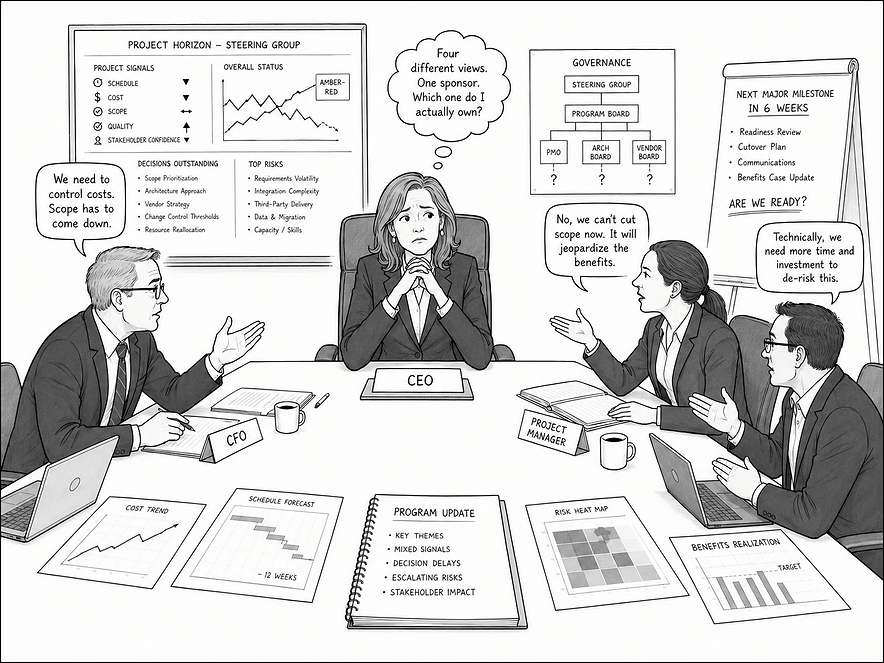
The sponsor’s control problem
Most complex projects do not fail because no one is managing them.
They have project managers, steering groups, risk registers, status reports, budgets, plans, milestones, dashboards, suppliers, frameworks and escalation paths.
On paper, they are governed.
And yet, the project may still lack the conditions required to succeed.
That is the sponsor’s control problem.
The sponsor carries accountability for the outcome, but may not have the signals, decisions and practical handles needed to protect value in time.
The reports are positive, but not convincing.
The risks are listed, but not really mitigated.
The budget is monitored, but the original estimate may already be unrealistic.
The plan is updated, but no one can explain with confidence what “progress” really means.
The steering group meets regularly, but the difficult decisions arrive late, unclear or politically softened.
The project team is busy, but the sponsor cannot easily tell whether the project is becoming more valuable — or merely more expensive.
This is where weak project conditions become a sponsor problem.
The project may look governed, but the governance structure may not match the real complexity of the challenge.
Asking for more reporting rarely solves this. In many cases, it only creates a more detailed version of the same uncertainty.
The deeper question is not whether the project is being managed.
The question is whether the project has been given conditions strong enough to succeed.
When ordinary governance creates false confidence
Traditional project governance works well when the challenge is predictable enough. If the scope is stable, the tasks are known, the technology is mature, the stakeholders agree, and progress can be measured against a reliable baseline, then budgets, plans and milestone reporting are powerful management tools.
But complex IT, AI and product-development projects are different.
The real needs may not be fully understood at the beginning.
Stakeholders may learn what they need during the project.
Technical uncertainty may change the solution space.
Architecture decisions may create long-term consequences no status report can easily show.
Suppliers, business owners, users and technical teams may operate with different assumptions about what success means.
Risks may not be independent; they amplify each other.
Small delays in decisions may create large hidden costs.
And early political compromises may later reappear as expensive engineering reality.
In that environment, classic governance can create an illusion of control.
The project may appear well-managed because the formal structures are in place. But the sponsor may still be receiving the wrong insight too late.
This is where bad surprises are born.
The missing question in standard assurance
Standard project governance, gate reviews and public assurance processes are valuable.
They help organizations assess risk, improve discipline and challenge whether a project is ready to proceed. In Denmark, Statens It-råd has institutionalized this logic for major government IT projects through risk assessments, management advice and follow-up. Internationally, models such as the Australian Digital Transformation Agency’s Delivery Confidence Assessment use a broader view of delivery confidence, including governance, leadership, capability, stakeholder engagement, technology and solution context.
But many assurance approaches still begin after an important assumption has already been made:
that the chosen governance model is the right one.
For complex IT, AI and product-development projects, this is often the critical question.
Not simply: Is the project following the model?
But: Does the model fit the project?
And more fundamentally: Are the conditions around the project strong enough for success to be realistic?
The missing layer: governance fit
A complex project needs more than a project management method and a steering group calendar.
It needs governance fit. Governance fit is one of the central conditions for project success.
Governance fit means that the structures around the project are designed for the actual complexity of the challenge — not merely for the organization’s normal reporting routines.
It means asking questions such as:
-
Are the right decisions being made at the right level?
-
Is decision latency visible and actively reduced?
-
Are risks being mitigated, or merely documented?
-
Are stakeholder expectations aligned well enough to support design decisions?
-
Are quality goals explicit enough to guide progress?
-
Is the steering group seeing leading indicators, or only lagging symptoms?
-
Does the sponsor have a realistic view of capability, complexity and uncertainty?
-
Are early assumptions and constraints being challenged before they become expensive facts?
These are owner-side questions.
They are not the responsibility of the supplier alone.
They are not solved by the project manager alone.
They are not always visible to the PMO.
And they are rarely handled well by ordinary status reporting.
They belong on the sponsor’s side of the table.
Why the sponsor needs an independent governance view
The accountable sponsor carries the business responsibility, but often has the least time to investigate whether the governance structure is actually working.
That is a dangerous asymmetry.
The sponsor is expected to protect the business case, ensure progress, handle risk, align stakeholders, support the project team, challenge suppliers, prepare steering group decisions and explain the project to the board — while still running the rest of the business.
In simple projects, this may be manageable through ordinary governance.
In complex projects, it often is not.
The sponsor needs an independent view of the governance system itself: how decisions are made, how risks are surfaced, how progress is understood, how expectations are aligned, and how early signals are turned into action.
This role is comparable to the client advisor in construction: someone on the owner’s side who helps the accountable owner become a more competent and better-informed buyer, sponsor and decision-maker.
For complex technology, AI, product-development, engineering and infrastructure-related projects, the equivalent is owner-side governance advisory focused on better conditions for success.
The real problem is not lack of control. It is the wrong control structure.
When complex projects begin to struggle, organizations often respond with more of the same:
More reporting.
More budget follow-up.
More steering group slides.
More escalation.
More pressure on deadlines.
More requests for certainty.
Sometimes this is necessary. Often it is not enough.
If the real problem is underestimation, more budget reporting will not restore control.
If the real problem is unclear expectations, more milestone tracking will not reveal real progress.
If the real problem is decision latency, more status meetings may simply make the delay more visible.
If the real problem is weak quality goals, the project may deliver scope while missing value.
If the real problem is governance mismatch, adding more governance may only create more noise.
The objective is not more governance.
The objective is better governance.
Better governance gives the sponsor earlier warning signs, clearer decisions, more realistic progress insight, stronger risk visibility and a better understanding of whether the project is still capable of delivering the intended value.
From reporting to real sponsor control
Real sponsor control in complex projects is not about knowing every detail.
It is about having the right structures, signals and conversations early enough to act.
That requires three disciplines that are often missing or underdeveloped.
First, expectation quality: the ability to align needs, requirements, risks, quality goals and validation before technical execution turns unclear expectations into expensive rework.
Second, early risk pattern recognition: the ability to identify project-initiation risks — such as underestimation, capability gaps, underestimated complexity and decision latency — before they become visible as cost overrun or delay.
Third, sponsor-level governance design: the ability to establish decision structures, steering group practices, escalation paths, progress insight and stakeholder access that match the real complexity of the project.
This is the space where owner-side governance advisory creates value.
It helps the sponsor establish or regain control — not by taking over the project, but by improving the governance structures around it.
Decision latency
The delay between when a project needs a decision and when the organization is able to make it.
Why it matters
Late decisions create hidden cost long before they appear as formal delay.
Governance fit
Standard governance asks whether the project follows the model.
Governance-fit advisory asks whether the model is appropriate for the project’s real complexity, uncertainty, decision needs and sponsor capacity.